
Pyramid Recalibration
Discover
EN

A standardized verification tool
for surgical system accuracy

Our Standardized Accuracy Verification Solution
Camera accuracy is only one element of reliable surgical tracking.
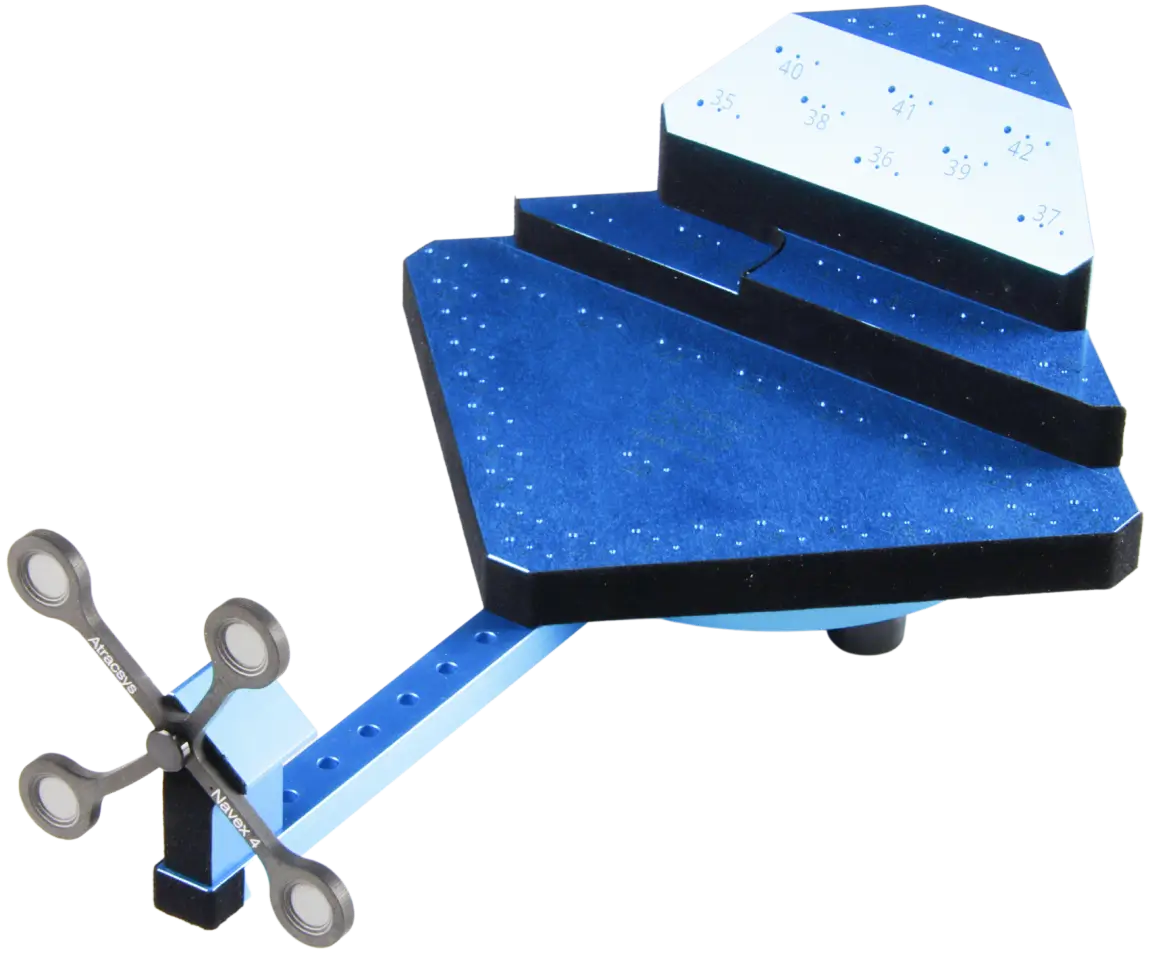
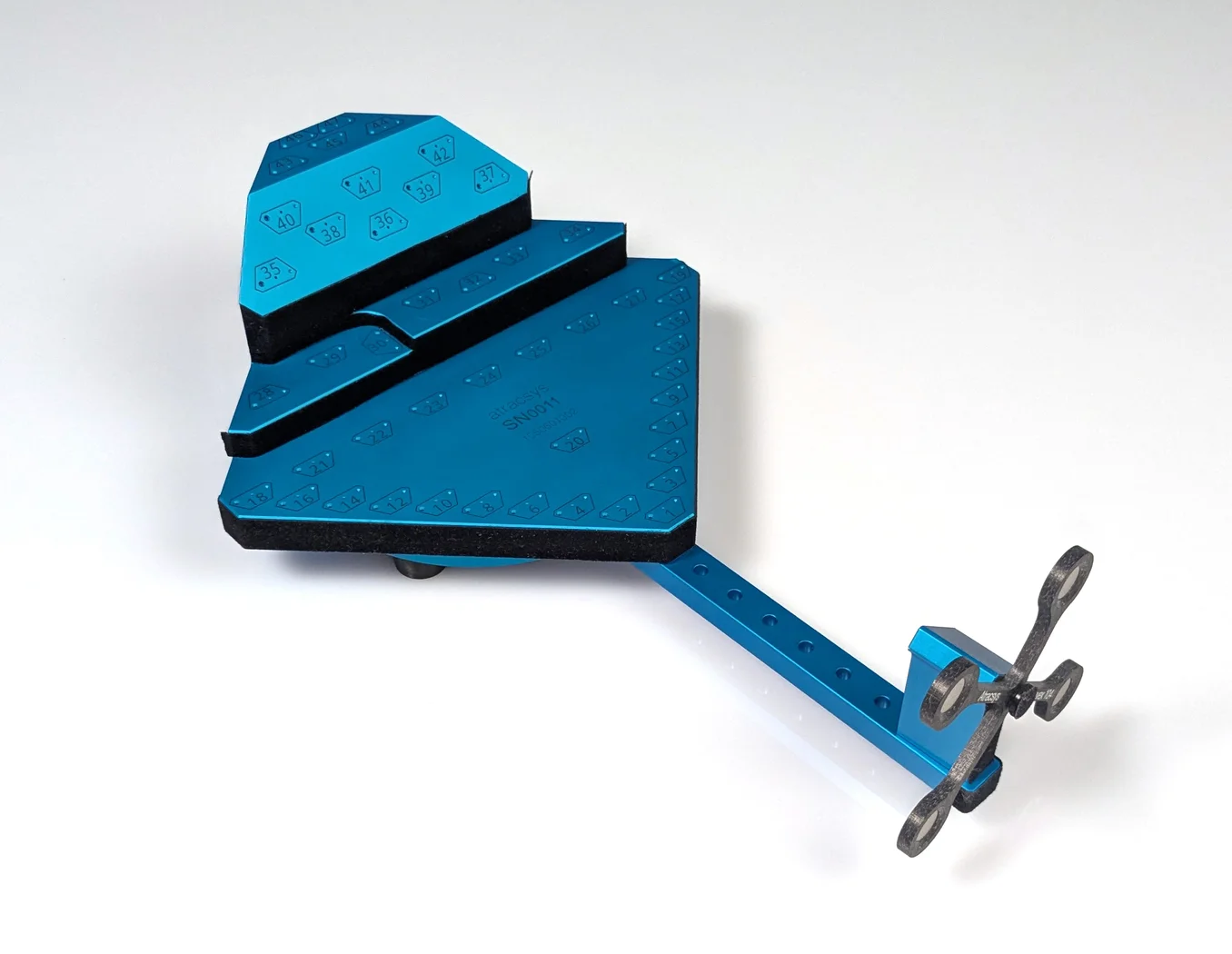
Developed in accordance with the ASTM F2554 standard, the Atracsys ASTM Phantom provides surgical system manufacturers with a metrological reference.
It allows to evaluate their complete tracking chain against an industry-recognized benchmark for 3D positional accuracy.
ASTM F2554 is the standard practice for measuring and reporting the 3D positional accuracy of computer-assisted surgical systems and robotic positioning setups.
Recognized as a consensus standard, it provides an objective methodology to evaluate point-localization accuracy, measurement repeatability, and orientation sensitivity, assessing the complete configured tracking system (pointer, marker geometries, reference element, tip calibration and system software) and not just the camera.
High-precision measurement object containing reference divots at known 3D positions
Delivered with certified 3D coordinate files for exact point-by-point comparison
Compatible with any tracked pointer or reference geometry, including Atracsys markers such as Navex™ and Tindax™
Full tracking chain assessment with an open-source evaluation software module based on 3D Slicer
Compare system-reported pointer-tip coordinates directly against physical, CMM-certified reference positions
Reveal potential inaccuracies (such as pointer calibration drift or coordinate transformation errors) that camera-only specifications cannot represent
Generate structured positional-accuracy evidence using defined metrics, including Mean, RMS, and Maximum Error and comparable benchmarkings
Thanks to an open-source software that also provides a reference workflow for ASTM F2554-aligned evaluations
Produce objective, structured positional-accuracy documentation to support OEM development, quality control, and regulatory verification activities
How it works
Note: The optical camera tracks the marker geometry attached to the pointer, not the tip directly. The system under test calculates the tip position using pointer calibration. The Atracsys ASTM Phantom verifies the performance of this entire calculation chain.
Note: The optical camera tracks the marker geometry attached to the pointer, not the tip directly. The system under test calculates the tip position using pointer calibration. The Atracsys ASTM Phantom verifies the performance of this entire calculation chain.
Note: The optical camera tracks the marker geometry attached to the pointer, not the tip directly. The system under test calculates the tip position using pointer calibration. The Atracsys ASTM Phantom verifies the performance of this entire calculation chain.
Note: The optical camera tracks the marker geometry attached to the pointer, not the tip directly. The system under test calculates the tip position using pointer calibration. The Atracsys ASTM Phantom verifies the performance of this entire calculation chain.
Note: The optical camera tracks the marker geometry attached to the pointer, not the tip directly. The system under test calculates the tip position using pointer calibration. The Atracsys ASTM Phantom verifies the performance of this entire calculation chain.
ASTM F2554-22 is a standardized methodology for measuring and reporting the positional accuracy of computer-assisted surgical systems, including surgical navigation and robotic systems. It provides a consistent way to evaluate how accurately a tracking configuration localizes known positions in space. For more details, consult the official standard.
The Atracsys ASTM Phantom provides a precisely characterized reference object that supports positional-accuracy testing in accordance with ASTM F2554-22. It enables OEMs to generate objective and repeatable accuracy data for their tracking configurations.
ASTM F2554 focuses on point-localization accuracy, precision, point-to-point accuracy, and sensitivity to pointer orientation. The objective is to evaluate how accurately a tracking system localizes a tracked instrument at known positions.
No. ASTM F2554 is a standardized test methodology, not a certification program. Testing according to ASTM F2554 generates objective accuracy data but does not result in an ASTM certification.
Yes. ASTM F2554 is listed by the FDA as a recognized consensus standard for medical devices. This recognition applies to the standard itself, not to the Atracsys ASTM Phantom or to any specific navigation or robotic system.
Yes. Each phantom is supplied with characterized coordinates and a measurement certificate that establishes the reference positions used for ASTM F2554 testing.
Yes. Atracsys provides a software tool to facilitate ASTM F2554-aligned testing workflows and help users perform standardized accuracy assessments with the ASTM Phantom.