
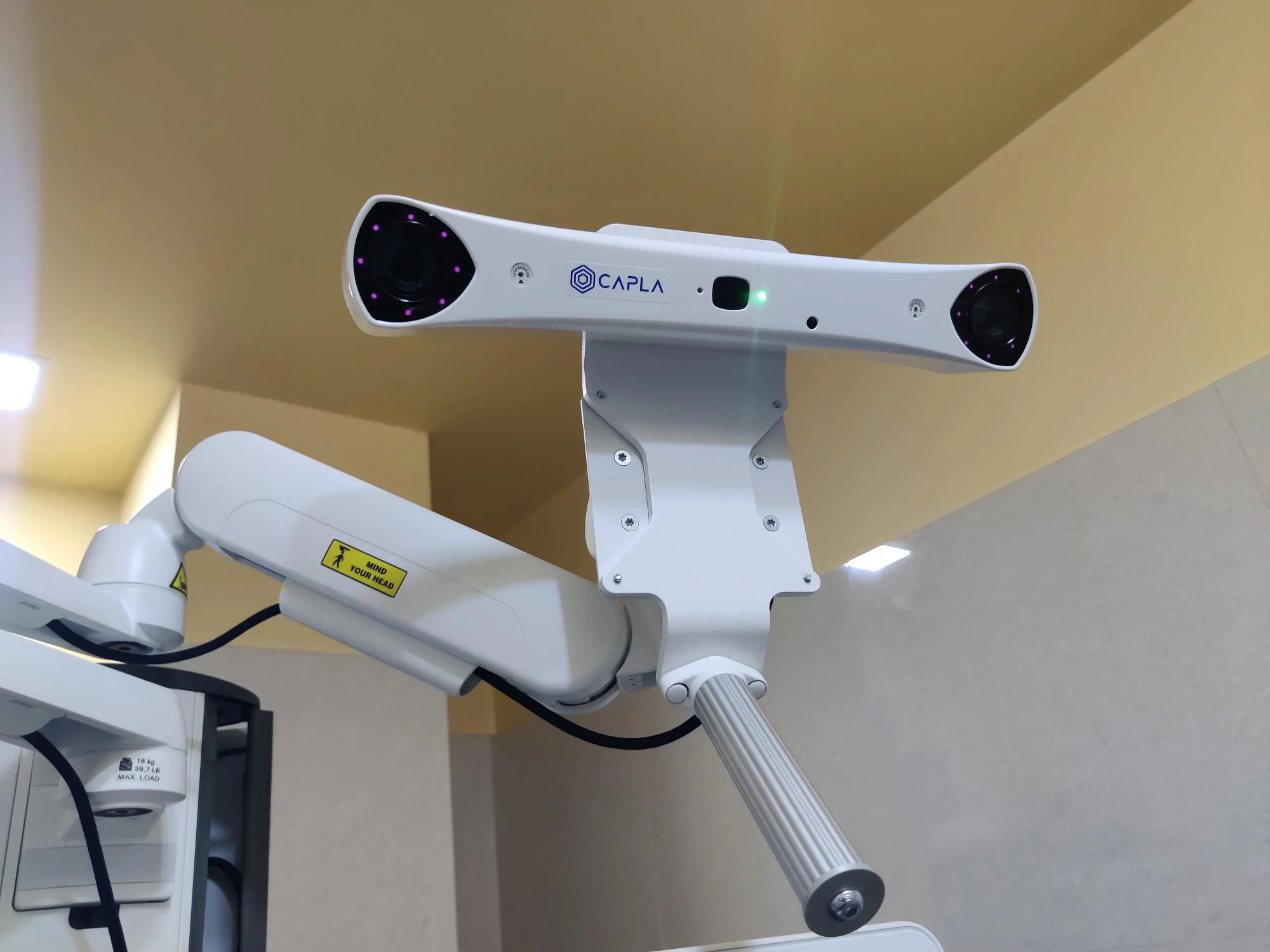
Patient registration is essential to surgical navigation, but conventional manual registration can add setup time and workflow complexity.
With Compass, CAPLA set out to simplify patient registration by using a 3D reconstruction of the patient’s head surface. By leveraging the 3D reconstruction and optical tracking capabilities of Atracsys’s spryTrack™ 300, CAPLA developed a compact workflow that brings its cranial navigation system closer to markerless patient registration.
Conventional manual registration requires healthcare professionals to collect points on the patient’s anatomy using a tracked pointer. CAPLA wanted to reduce this hands-on preparation by automating patient registration, matching a 3D reconstruction of the patient’s head surface with the preoperative image. The challenge was to introduce 3D surface reconstruction without adding a separate surface scanning device alongside the optical tracking camera.
For CAPLA, that would add hardware complexity, integration effort, and footprint around the operating table. The challenge was to keep the system compact while supporting four workflow requirements:
- Reconstruct the patient’s head surface in 3D for registration
- Register the patient by aligning the 3D surface with the preoperative image
- Track surgical instruments during navigation after registration
- Control the workflow through one camera interface without adding extra hardware
CAPLA built the Compass cranial workflow around the spryTrack™ 300. At the start of the procedure, the camera is positioned close to the patient to capture the head surface as a 3D point cloud. CAPLA’s registration software then uses this surface data to align the patient with the preoperative image.
Once registration is complete, the same camera is moved away from the sterile field and used as the optical tracker for navigation. This avoids the need to switch between separate vision systems and keeps 3D surface reconstruction, registration, and tracking within one connected workflow.
The compact form factor and flexible mounting of the spryTrack™ 300 also supported CAPLA’s cart-based design, allowing the team to integrate the camera without redesigning the system around the tracker.
The spryTrack™ 300 enabled CAPLA to combine two functions that would otherwise require separate hardware: 3D optical tracker for patient registration and optical tracking for navigation.
For CAPLA, Atracsys contributed more than the camera itself:
- Integrated 3D surface reconstruction and optical tracking in one compact device
- Single API for software integration and system control
- Flexible mounting to support CAPLA’s cart-based system design
- SDK documentation and direct technical support to accelerate development
Together, these elements helped CAPLA move faster from concept to clinical testing while giving Compass a differentiated technical foundation.
The result is a more streamlined cranial registration workflow built around the patient’s anatomy. Based on feedback collected by CAPLA across clinical cases, the registration process is now substantially faster.
Patient registration can traditionally take 15 to 30 minutes. With our 3D registration workflow, we are consistently completing it in approximately 3 to 5 minutes, making navigation faster and easier to introduce into the surgical workflow.
— Gowtham Palani, Director of Products and Customer Success, CAPLA
For CAPLA, this creates a clear product advantage: a simpler system architecture, fewer components to integrate, and one technology platform for patient registration and optical tracking. The same camera platform also supports optical tracking in Compass spine and ENT applications, while CAPLA is exploring its integration into future surgical robotic systems.
For clinical teams, the benefit is a faster and more flexible workflow in the operating room. The camera can be positioned close to the patient for 3D reconstruction, then moved away for tracking, reducing registration time without adding another vision system.
By bringing 3D reconstruction and optical tracking together in one compact system, CAPLA and Atracsys simplify patient registration for cranial navigation workflows without adding a separate scanning device.
Capla GmbH is a German medical-technology company headquartered in Fahrenzhausen, near Munich, dedicated to advancing neurosurgical care through digital surgery. Its ecosystem spans AI-driven preoperative planning, real-time intraoperative navigation, advanced 3D imaging and robotic-assisted positioning.